Tuesday, March 16, 2010

Prototype2Print-n-Play: TUG OF WAR


I mentioned in the design notes to Alea Iacta Est that it all started out with a challenge I gave to Bernd to enter a contest for 2-player dice games. I also posted my original game here, titled Castles & Crowns, which was later developed further into Alea Iacta Est. I always thought that Bernd's answer to my challenge was a great little game as well, and for some time, I have wanted to make it available for others to enjoy. It's a very simple and elegant game that can be played with a few materials you already have. We tried it at the end our game night again last night, and I highly recommend it! -Jeff

Sunday, July 12, 2009

Prototype2Publisher: EINE FRAGE DER ÄHRE (HEARTLAND)


Back to the Roots: Tilling the Ground for a New Game Idea

This is a game that most certainly started with the theme: farming in the Midwest of America where I grew up, where the 1-mile-square fields of different crops look like traditional game board from an airplane.

My mother grew up on a farm, and I spent plenty of time in my childhood with my grandparents and uncle there. Planting and harvesting crops seemed like an intriguing theme for a game, especially when factoring in “crop rotation”, in which fields are planted with different crops year after year. I was interested more in designing a family game, however, something that my Iowa relatives would enjoy playing, and so I had to abstract the theme quite a bit in order to keep the rules accessible.

The Seeds are Planted

My first step was to design a board of squares with five different crops represented. Then I added domino-style tiles with two different crops on each. Players had a hand of these tiles to place on the board and form larger “fields” or chains of the same crop. But due to crop rotation, a player could never cover a crop with a tile of the same crop. The stacking of the tiles also necessitated a second placing rule, which is fairly intuitive: new tiles could not be placed over fields on different levels.

This starting framework was still one-dimensional, and very dependent on a good tile draw. More options for the players were necessary. The next layer, then, was the one or two “barnyard points” printed on each square of each tile. These allowed players to advance on a track matching that type of crop. Reaching a certain point with the markers on the track allowed a player to place a barn on the board and reserve a nicely-developed field of crops for herself. Each player had one of these “development tracks” on a player mat in front of him.

Cultivating the Design

I finally play-tested the game with friend and designer Bernd Eisenstein and his girlfriend, and they were both very enthusiastic. After testing it further, however, it seemed that the barnyard tracks could offer more than just the opportunity to place the barns—they could also increase the competition in the game by providing a race to the top of each track for bonus points. These bonus tiles became the “livestock” and rewarded the first player to reach them with extra points, while the second-place player received a lesser amount.

Now that there was competition involved, it made sense to put these tracks on the board so that players could compare their positions at a glance. To make the turns more interesting, I then made it necessary for the players to choose between these barnyard points and the harvest points (or victory points) for each field.

I also added one single-square tile of each crop for each player to use at any point during the game to allow greater flexibility, in case a player could not draw the tile she needed at an important time, and also useful in “leveling out” two fields to make it possible to place a double tile there.

I was finally ready to let the “experts” in our weekly game group try it out, namely Hartmut Kommerell, Thorsten Gimmler and Andrea Meyer. I was a bit nervous, as this was only the second prototype I had ever taken to the group, where they were always playing each other’s prototypes. But it was received well again, and I had more valuable feedback to tweak the design and the courage to bring it back to the group regularly to play-test.

The last major changes in the design were the result of their feedback: randomizing the bonus Livestock Tiles a bit (but still awarding the more valuable ones to the fastest player) and keeping them hidden until the end of the game. This kept the winner of the game in doubt, adding tension and keeping the last round from slowing down too much, as players calculated and re-calculated their scores to see how they could best take the lead or keep it. And I also added an “End of Game” tile which made the timing of the final round unknown to the players.


Harvest Time

That summer I traveled to the Game Designer’s Convention in Göttingen for the first time with Hartmut, and, with his help, I was able to demo the game to several publishers who all wanted copies of the prototype afterwards. Several months later, Pegasus Spiele offered me my first game contract. Their intention was originally to publish it the following year, but several things slowed down the process.

First, they were considering producing the game in a more abstract, all-wood edition, but the prototypes received from China were not of the quality they had wanted. I was not terribly disappointed, as I preferred the more thematic approach of artwork on cardboard (perhaps I’m too “old school”) and even suggested acquiring the rights to Iowa artist Grant Wood’s famous painting “American Gothic” for the box cover.

Soon after that, a new developer at Pegasus got involved with the design and worked together with me to further tweak the game. During that time, we went ahead instead with my card game “Circus Maximus,” opting to continue developing “Heartland” until it was as good as we could make it. Then they decided on a much more German name, a play on words with the German expression (and German title of the film “A Few Good Men”) and farming terminology. “Herzland” was a term once used by Hitler to describe Russia’s bread basket, a taboo the game certainly did not need.

Still, the artwork is clearly rural America, and it has honestly been a relief to finally get the project “out the door” and into the market after all this time. I feel that the finished publication is worth the wait.


--Jeffrey D. Allers

Review on Boardgamegeek

Cover photo courtesy of Pegasus Spiele GmbH

Wednesday, March 4, 2009

Prototype2Publisher: ALEA IACTA EST


A Friendly (Design) Competition:

Back in 2006 I heard about a game design competition on the internet for 2-player games using components that were common in every household (playing cards, dice, pawns, poker chips etc.). Each year, they also had a theme for the competition, and that year it was “dice games.” Since I had been designing games with Bernd Eisenstein, I thought it would be fun to challenge him to a “contest within the contest” to see what each of us could come up with. Because they were 2-player games, we could easily play-test our ideas. I came up with two different games, and Bernd came up with a cool take on Tug-o-War using dice and pawns.

One of my games was titled Castles and Crowns and involved placing groups of dice in order to win various cards: Castles which were worth a set amount of points, and Nobles who were worth more as sets. There were also special dice, such as Mercenaries, Captains, and Traitors, that had special functions along with each player’s 8 Knight dice.


Transformation to a board game:

As it turned out, I missed the deadline for the competition, but it must have been discontinued anyway, as no results were ever posted. I put the idea to the side while I worked on other projects, but after a year, I came back to it. I began thinking of more dimensions I could add to the original framework. The idea of making a full-fledged board game out of it became exciting to me, especially when it combined two of the hottest current mechanics in gaming at the time: dice and worker placement.

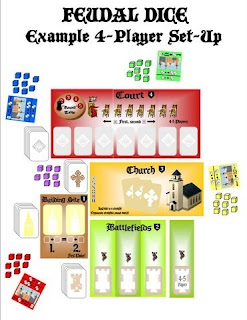
The important thing in developing the game further was to provide enough placement options to players so that they could do meaningful things with any dice roll. My next prototype was called “Feudal Dice” and included a board with 3 different areas where dice could be placed. The battlefields, where Castle Cards were awarded to the player with the most dice in each, were very similar to my original idea. To that, I added a Court, where lower dice would be more valuable in winning Noble cards. The Nobles were only worth points, however, when housed in a castle of matching color. A maximum of two nobles could be housed in a castle, one male and one female. There were also special nobles who provided end-game bonuses. This added a set-collecting element to the game. The third area for dice placement was the Market, where dice of different numbers could be placed on various stands to earn money. This was important to give players another option when they rolled dice of different values. The money earned from the Market could be used to pay for extra dice (the Mercenaries) or as bonus victory points at the end of the game.

After several playtests, I felt that there needed to be further uses for the money in the game, and I also wanted cards that allowed player’s special rule-breaking powers when rolling and placing their dice. I created a fourth area of the board, the Building Site, where two special buildings were up for sale each round, costing one die each and an amount of money (which decreased each round, since the buildings could not be used as often if built late in the game).


The Die is Cast...with a Publisher:

I sent the game to a German publisher, who liked it very much, but their program was so full at that time that they recommended I shop it around for a few months and possibly enter it in the Hippodice competition. Another German publisher playtested in for half a year, and it just missed their final cut, so I took it to Nuremberg, where I showed it to Stefan Brück of alea.

He was very interested, and even suggested we change the game to a Roman theme and name it “Alea Iacta Est” to go with the publishing company’s title. But I had to move back to the U.S. for 6 months, and Stefan likes to work closely with his designers. I asked Bernd if he would be interested in becoming my co-designer since he was familiar with every iteration of the game and had participated in its development from the start. He gladly accepted and worked hard together with Stefan in fine-tuning the game and play-testing it extensively.


A Triumvirate: Three Heads are Better Than One:

The first thing to go was the money, as the dice were the real “currency” in the game. Instead, the nobel cards that offered special end-of-game bonuses were moved to the market area of the board (renamed the “Church”), where “straights” of dice would continue to be placed. The winner there chose from 3 face-down cards, however, so that the other players would not know which bonuses were in their opponent’s hands.

The special dice—the captains, mercenaries, and traitors, were also removed from the game. Forty dice were the maximum that Stefan could include, and that was just enough for the 8 dice per player in a 5-player game.

The battlefields, which previously held one castle card each, were reduced to one battlefield where the winner had first choice of the face-up cards, second place could choose next, etc. This increased the competition considerably.

The court went through several iterations, ranging from guaranteed seats for each player to the final mechanic of the lower dice pushing the higher ones out the back door! The court also awarded players who were placing dice later in the round, which provided a nice balance to the battlefield, where it was advantageous to place dice early in the round.
And finally, Stefan thought that it was too frustrating for players to invest large amounts of their dice on the board only to come up empty-handed, so we added “re-roll chips” that could be used by players later in the game or turned in for bonus victory points at the end.

At the end of the summer I was also able to test the game in its current form with a couple of different gaming groups in South Carolina. They were very gracious in trying out a prototype from a complete stranger! This allowed me to develop the Senat cards further, increasing their number to 19, and to bring my own feedback to Bernd and Stefan as I prepared to return to Berlin in October.

Examples of the Building Cards which were cut from the game


Then in November, Stefan came to Berlin for two days of intensive play-testing. We had finally decided that the building cards, which had provided special actions when rolling or placing dice, added too many rules without enhancing the game play significantly. But we needed a fourth area for dice placement, so Bernd and I came up with four different options to try. They were all interesting in their own right, but in the end, we did not use any of them because they detracted from the heart of the game. Instead we developed a fifth option during play-testing that we decided to use in the finished design. In any case, there are plenty of ideas for expansions!

And of course, we finally made the changes in the theme so that the battlefields were now the barracks or “Castrum”, the court was now the Forum Romanum, the church became the “Senatus”, and the market became the “Templum.”


Photo of finished game courtesy of Alea and Ravensburger

Friday, February 13, 2009

Prototype2Print-n-Play: CASTLES & CROWNS


A Dice Game for 2-5 Players by Jeffrey D. Allers

Background:
Back in 2006 I heard about a game design competition on the internet for 2-player games using components that were common in every household (playing cards, dice, pawns, poker chips etc.). Each year, they also had a theme for the competition, and that year it was “dice games.” Since I had been designing games with Bernd Eisenstein, I thought it would be fun to challenge him to a “contest within the contest” to see what each of us could come up with. Castles and Crowns was one of my ideas for the competition, and although I missed the deadline for it, the game later provided inspiration for the board game Alea Iacta Est published by alea. The games are miles apart--after more than two years of development, Bernd Eisenstein's design skills and Stefan Brück's developing talents, Alea Iacta Est is much more multi-dimensional and balanced--but I feel that the original C&C is still worth offering to those looking for a game they can play with materials they already have.

Game Idea:
In this medieval dice war, players try to use their knights to capture castles and influence the nobles who vie for the power of the crown. The player with the most points from their castles and influence on the crown (through nobles) at the end of the game wins.

Components:

32 Cards from one standard deck:
Use the numbers 2, 3, 4, 5, and 6 of each suit to represent Castles of different
values (20 cards total).
Use the Kings, Queens and Jacks of each suit to represent the Nobles
(12 cards total).

10 six-sided dice for each player:
1 white die to represent that player’s “Captain”
1 black die to represent that player’s “Traitor”
8 dice in another color to represent that player’s Knights
(each player needs a different color for their Knights, unless playing with only 2 players).

4 brown dice to represent the “Mercenaries”

A Starting Player Token

Preparation:
Each player takes one Captain die and one Traitor die together with his/her Knight dice and places them in front of him/her.
Shuffle all the cards together and place in a face-down deck.
The first starting player takes the Starting Player Token.

Beginning of each round:
Draw the top six cards from the deck and place in a row face-up in the middle.
These represent the Battlefields for the round.
Roll the 4 Mercenaries and place next to the Battlefield row.

Player Turns:
1) Roll all of your dice representing the Knights that have not yet been sent into battle
2) Then arrange the dice rolled into groups according to rank (number of pips on each die).
3) Finally, send one group of Knights (which may or may not include the Captain and Traitor) into battle by placing them on next to one of the face-up Castle or Noble Cards.

You must send all Knights of the same rank into battle each turn.
Once you send Knights of a certain rank to a battlefield, you may not in future turns send Knights of the same rank to another battlefield (one rank per battlefield per player allowed). You may, however, reinforce Knights already placed at a battlefield with a group of new Knights of the same rank.
You may not send Knights to a battlefield where one or more Knights of the same rank have already been placed.

The Captain: The Captain counts as two Knights at a Battlefield. He is sent into battle in the same way as a Knight, with the exception that a Captain can never be at a Battlefield alone (or alone with a Traitor). If the Captain is the only die rolled with a certain rank, and there are no Knights matching that rank on any of that player’s Battlefields, he cannot place that Captain this turn.

The Traitor: The traitor counts as one Knight when determining the winner of a battle. He is sent to the Battlefield together with one or more Knights of the same rank, in the same way as the Captain. His position, however, is never completely secure. When the opposing player sends a group of knight(s) and/or a captain to battle matching the traitor’s rank, that player takes the traitor die from its previous location and adds it to the his group at the new Battlefield.
The traitor may change sides any number of times during the round. Each time his rank is rolled and the matching dice are sent to battle, the traitor joins them.

The Mercenary: The mercenary counts as half a knight when determining the winner of a battle (useful as a tiebreaker when players have the same number of dice at a battlefield).
When a player sends a group of Knight(s) and/or a Captain into battle that match the rank of one of the Mercenaries, that player takes the Mercenary and adds it to his group at that Battlefield. Unlike the traitor, however, the mercenary remains there until the end of the round. Note: even when there are several Mercenaries of the same rank, a player may only ever take one Mercenary per turn.

End of the Round:
When one player has sent his last Knight into Battle, or, after rolling, cannot send any of his Knights into battle, the round is played to its conclusion (up until the player with the starting player marker).
Then the round ends and the winners of each battle are determined.
The player with the most Knights at each Battlefield wins that Castle or Noble card. (Captains count as two Knights, the Traitor counts as one Knight, and the Mercenary counts as half a Knight).
If the number of Knights is the same, then the Knights with the higher rank win the battle.
Castles (numbered cards) captured are placed face-down in front of you.
Nobles (face-cards) captured are placed face-up in front of you.
Each player takes back his/her Knights, Captain and Traitor dice.
Pass the Starting Player Token to the player on the left.

End of the Game:
After 5 rounds, the game ends (there will be 2 cards left over from the deck).
Each player adds the numbers on his/her Castles.
Player also receive bonuses for their Nobles:
If one card of a Noble type (J, Q or K) is collected, it is worth 2 points, 2 are worth 6 points total, 3 are worth 12 points, and all 4 are worth 20 points)
The player with the most points wins.
In case of a tie, the player with the most cards captured wins.

VARIANT SUGGESTIONS (not part of the original competition entry):

Less Cards Variant: For more competition (especially with less players), decrease the number of cards available per round and play more rounds (8 rounds with 4 cards each, for example).

Combined Traitor/Mercenary Variant: You may also combine the functions of the Traitor and Mercenary dice: take the black dice out of the game. Roll the four brown dice at the beginning of each round and place to the side as Mercenaries. Whenever a player adds Knights to a Battlefield matching the rank of at least one of the Mercenary dice, he/she must add that Mercenary to his/her Knights at that battlefield.
Whenever a player adds Knights to a Battlefield matching the rank of at least one Mercenary die already on a Battlefield, he/she takes it from that Battlefield and adds it to the Knights he/she is placing. If there is more than one Mercenary of the same rank on the Battlefields, he/she may choose one to move. If there is still a Mercenary of the same rank in the reserve, however, he/she must take that one.

Straights Variant: Instead of placing a group of dice of the same rank at a Battlefield, a player may place a “straight” of dice (or add to a straight already on a Battlefield) of different values (For example: 2-3-4-5). A Captain in a straight is still worth 2 Knights, a Mercenary is worth ½ a Knight, and a Traitor may only be placed at one end of the straight—not in the middle (in case it defects later in the round).
A straight of Knights are worth less, however, than a set of the same number of same-rank Knights. (For example: four 1’s are worth more than the straight 2-3-4-5).
A player may not place a straight on a Battlefield that is identical to another player’s straight. When there are two straights on a Battlefield, the straight made up of more dice wins. If the same number of dice, the straight with the highest die wins (For example: a player can beat another players 2-3-4-5 straight with 1-2-3-4-5 or with 3-4-5-6).

Friday, December 26, 2008

Prototype2Print-n-Play: TRIM THE TREE


TRIM THE TREE
A holiday game for 1-5 players
by Jeffrey D. Allers


GAME IDEA:
If you like puzzle games, or if you simply enjoy the surprise of seeing what kinds of ornaments are in each box as you decorate your Christmas tree, you might enjoy "Trim the Tree." Play alone or with up to 4 opponents and try to score the most points by having the tree with the most balanced decorations in color and shape.


MATERIALS:
5 Christmas Tree boards:
5 Star scoring markers:


80 Ornament counters (in 4 different shapes and 4 different colors):
1 Ornament Box tile with overview of the scoring:
1 cloth Bag (Christmas stocking or Santa cap recommended)


PREPARATION:
Each player takes a Christmas Tree and a Star.
Place the Star next to the scoring space marked „0“ on the Tree.
With only 3 players, take one set of 16 Ornaments out of the game.
With only 2 players, take out two sets (32 Ornaments total).
If playing solataire, take out 3 sets (or 4 sets for a more calculating version).
Place all the remaining Ornaments in the Bag and give to the starting player.
Place the Ornament Box in the middle.

GAME ROUNDS:
1) Open a box of Ornaments: the starting player draws as many Ornaments from the Bag as the number of players and places them on the Box.

2) Trimming the Tree: starting with the starting player and continuing clockwise, each player chooses an Ornament from the Box and places it on an empty space on her Tree.
A space is represented by the intersection of 2 or 3 lines on the Tree.
After the first Ornament is placed, players must place each new Ornament on a space adjacent to an Ornament already on her Tree.

3) Scoring: if an Ornament placed completes one or more triangles on the Tree, that player may score points for the triangle(s) if all 3 Ornaments in each triangle are of a different color and shape.
One triangle completed in this ways scores 1 point. If an Ornament completes two triangles, and each of these includes Ornaments of different colors and shapes (but Ornaments of one triangle may match the color and or shape of Ornaments of the other triangle), the two triangles score 3 points. Three triangles completed by the same ornament score 5 points. Four triangles score 7 points. Five triangles score 9 points. And six triangles score 11 points.

See Ornament Box for a summary of the scoring.

Any points scored by completed triangles are marked by moving the Star along the outside of the Tree so that it points to that player‘s current score.


Example: a player places a blue box ornament that completes two triangles on his tree at the same time. One triangle has a red bell and a yellow candle, the other has a blue bulb and red candle. The first triangle scores because all of the ornaments are of a different color and shape. The second triange does not score because it has two blue ornaments. The player scores 1 point total for the two completed triangles and moves his star one space around his tree. If that player had placed a purple box instead of a blue one, he would have scored 3 points total for both triangles.


Note: a player must always place an Ornament from the Box. The last player in the round does not have a choice as to which Ornament to take.


BEGINNING THE NEXT ROUND:
After the last Ornament is taken from the Box, pass the Bag to the player on the left.


END OF GAME:
When all the Christmas Trees are filled with Ornaments, the game ends. The player with the highest score places her Star on the Tree and wins the game. If there is more than one player tied for the highest score, the tied players share the victory.


THE FIRST PROTOTYPE AND BACKGROUND STORY:
The original idea and first prototype originated naturally at Christmastime several years back, when I found some nice wooden bits and Christmas tree-shaped box at a local hobby shop. Seasonal games are notoriously difficult to market, and publishers usually avoid them, so my motivation was strictly personal--to create a fun game for myself, friends and family to play over the holidays. The early version pictured above actually works fine as a game, but did not have the elegance and efficiency I was looking for. So, just as I have done every year this time of year, I brought out the bits and began thinking again about changes I could make. This year, in the interest of improving the design, I finally "let go" of my beautiful bits in favor of cardboard counters (or one could print the ornaments on wooden or plastic chips as well), and I think this is much more "my type of game," if there is such a thing.
And since I doubted a publisher would be interested, I decided to "self-publish" on my blog. Enjoy!


Wednesday, October 1, 2008

Prototype2Publisher: ...ABER BITTE MIT SAHNE (PIECE O' CAKE)


A Mouth-Watering Idea
I always liked the concept of “pie division” in a game, and the only real example of that kind of mechanic that I had ever come across was in Alan Moon’s San Marco and his two-player card game version Canal Grande. In both games, the pie division takes place between two or three players, however, and I’ve often wanted to design a game where one player divides the “pie” into multiple offerings for more than two players.

One of the challenges, of course, was to avoid making it so complicated that the task of dividing the pie would induce “analysis paralysis” in the players. The other challenge was to make sure the game was not too chaotic. Each player needed to be able to make meaningful choices each round that had some influence on the outcome of the game. At the outset, I was not certain this was even possible, especially for up to five players.

Finding the Right Ingredients
So I considered the abstract idea for a pie division game for quite some time before I finally decided that a theme might help flesh out a playable design. That’s when I finally settled on the obvious choice of dividing an actual pie and collecting the slices.

However, I always like to have multiple strategic options in the games I play, so I needed an option other than set collection and majority battles. That’s where the theme informed the design by providing the option of “eating” slices for guaranteed victory points. This game mechanism not only presented players with an interesting choice for each slice they took, but it also made the majority battles into a kind of perfect-information poker. I also liken it to “playing chicken”: are you going to challenge my majority in chocolate pie with that slice you are taking, or are you going to play it safe by “eating” the slice?


The theme also helped solve the potential problem of analysis paralysis mentioned earlier. Since the offerings that were to be divided were pie slices placed in a circle, it was only natural to keep the positions of the slices fixed, while deciding where to cut the pie. This limitation was vital in keeping the options manageable, and served to add excitement as the new pie slices were revealed each round. If players could have moved the slices around however they wanted (as they can with the cards in San Marco and Canal Grande), the dividing would have taken too long, and some of the challenge would have been missing.

The
name of my prototype was also an obvious choice for me, having enjoyed the song American Pie in my youth (and, for the record, I have no desire to ever see the film). Pie is also something my wife enjoys making for our German friends to give them a taste of America.


Putting it in the Oven
After thinking about the idea of the game for so long, it all came together rather quickly when I finally had the theme and these two mechanics written down. I made a quick prototype and brought it to our play-testing group, but I was almost too embarrassed to bring it out because I had not tried the game by myself yet and honestly didn’t know if it would even work. It did, of course, and Bernd Eisenstein especially liked it, which is always a good sign—every game of mine he’s been excited about has landed a publisher now! I did not need to make any changes before showing it at the Game Designers’ Meeting in Göttingen last year, where Winning Moves Germany snatched it up.

It was such an intuitive design, but I was still surprised at how everything fell into place. Because I had written the rules in such a relatively short period, playtesting the game was a voyage of discovery, exploring the different ways one could play the game. All of it worked smoothly from the start. And although I usually like to design through the prototyping process – often making mock-ups that are seen by no one but me – this one was mostly developed in my head.


Adding the Whipped Cream
After Winning Moves play-tested it, however, they requesting increasing the number of slices so that there would always be unequal divisions, even with 2 and 5 players. With the original 10 slices, for example, players would often feel pressured in a 5-player game to divide the pie into 5 portions of exactly 2 slices each. Since my original intuitive design was so well balanced (between majority points and guaranteed points), I now had to “do the math” to maintain that balance while adding more pieces to the game.

The theme and name were also slightly changed to reflect German cakes and a popular song here titled …aber bitte mit Sahne (“but please, with whipped cream”). The eating points were then cleverly symbolized by dollops of
whipped cream on each slice. When Rio Grande games picked up the game for U.S. distribution, I was asked to brainstorm English names, and submitted a list that included my original "American Pie." They chose "Piece o' Cake." Local publishers chose the titles for the French and Dutch versions.

I was also asked to work on some bonus slices with special effects that might be given away at Essen or other promotional events, or used as future expansions. The basic game can very easily be added onto, and even a powerful special action tile can be balanced out by a skillful divider. One of those, the Joker Slice, was later released in Spielbox magazine.

I almost forgot to mention a nice suggestion from Eric Martin, my esteemed Boardgamenews editor. Before I was offered a contract for the game, Eric and his wife came to visit me after the Essen Game Fair, and he gave me his copy of Qwirkle for being their Berlin tour guide. I wanted to give him something in return, but I knew that he did not have a lot of extra luggage space after the fair, so I gave him an American Pie prototype. After playing the game many times, he was the one who made the suggestion to divide the pie into four pieces in the two-player game, giving each player two turns to choose each round.

Many thanks to Michel Matschoss and Uli Schumacher at Winning Moves and to Eric for their input during the development of the game!

See a review

Video Review

Read the lyrics to the song ...aber bitte mit Sahne in English and German